Friday, September 29, 2017

Angraecum didieri

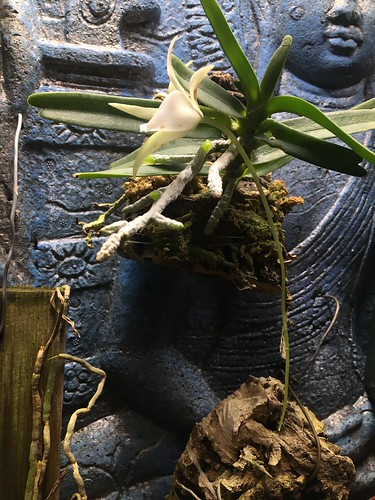
I have had another special orchid blooming this month, and it's another first-bloomer for me.  This is Angraecum didieri, native to Madagascar.  I got this about three years ago, as a small seedling.

I got a second terrarium last spring because I had several orchids, mostly Angraecoids like this one, that were not doing well at all.  My climate is just not humid enough for them, and they were showing severe stress from their roots drying out so fast and often.

Angraecum didieri in bud

Having them in the enclosed area helped a lot, and when I added an automatic misting system in mid-July, they all exploded with new roots and leaves.  All the side root branches in that picture above have grown in the two and a half months since the mister was added.

I noticed the bud developing around the middle of September and was so excited!

Angraecum didieri in bud

New buds are always exciting, and even more so when it's a species I haven't bloomed before.

Angraecum didieri in bud

This species is in the same group as the Aerangis punctata, Aerangis fastuosa, Aerangis citrata, and Aerangis mystacidii that I have shown on here before.  In general, this group has white star-shaped flowers with a long nectar spur that are large for the size of the plant, and most are fragrant at night to attract moths, their pollinators.

This one is no exception.  It opened on September 25.

Angraecum didieri

The plant is about six inches from leaf tip to leaf tip, the bloom is two inches across, and the nectar spur is six inches long.

Angraecum didieri

It is powerfully fragrant starting at about 7:00 at night, and smells of Stargazer lilies and gardenia.  It's a similar fragrance to A. mystacidii but a little less rich and honeyed, and not musky like A. fastuosa.

Thursday, September 28, 2017

Storing the bounty

Despite not having a veggie garden this year, I have been putting up food.  We very much enjoy eating from the canning pantry downstairs.

Nothing exemplifies this more than peaches.  There are few desserts Emma likes more than canned peaches, and opening a home-canned jar in January can't be beat.  So last weekend when we got home from the fiber festival I canned the two boxes I bought the week before, about 50 pounds of Elberta peaches.  Yum and double yum.

50 pounds of peaches

I have also made two small batches of pickles.  These are cukes from Anne's garden, after she decided that the approximately 40 quarts (I think?) of pickles she made this year was enough and she couldn't face making any more.

Rather than making regular vinegar pickles this time around, I decided to copy Anne and make lacto-fermented ones.  My mom used to occasionally make these in a big crock, but not having enough cukes to fill the crock, I opted for jars like Anne.

It's just cucumbers, a salt brine, and whatever spices you want.  The first batch I made according to Anne's favorite recipe (Mrs. Neusihin's recipe of Pacific Northwest fame), with garlic, dill, dry mustard, pickling spice, a grape leaf, a chunk of fresh horseradish and a hot pepper.  For the second batch I left out the horseradish and hot pepper, because I don't like spicy and I was scared.  I tried Anne's pickles when I was there a few weeks ago, and liked them, but still... horseradish and hot pepper...

So you put everything in a jar, lid it loosely, and leave it on the counter.  Then a couple times a day you tighten the lids and give the jars a shake, then re-loosen the lids to let the fermentation gasses escape.

When they start, the liquid is clear and the cucumbers are bright green. This is the second batch on Day 1.

Lacto-fermented pickles, day 1

Over the course of a week or so, the beneficial bacteria grows in the brine and makes it cloudy, while the cucumbers turn into pickles and become pickle-green.  When they are to your desired sourness, you tighten the lids and they are done.  I put mine in the fridge, which stops the fermentation.  This is what the first batch looked like at the end of Day 6.

Lacto-fermented pickles done on Day 6.

For the best flavor, it's good to let them ripen for at least 4 to 6 weeks before eating.  That means our first batch will be ready to eat at the end of October.  They smell fantastic, and we're having a hard time waiting.

Wednesday, September 27, 2017

Catch up

So apparently my blogging mojo left me after I got back from vacation at the end of August.  Now here it is the end of September and I've hardly posted at all this month.  Post-vacation re-entry to normal life is always rough, but this time seemed especially hard.  I just feel wrung out.

I have been taking some pictures of  pretty things in the garden as they show up, meaning all the while to post them but never seeming to get around to it.  (I've gotta get me one of those "Round Tuits"...)

So here's a big old catch up post of pretty things that have bloomed in the past couple months.

Stargazer lilies starting to open:
Stargazer lilies

Rudbeckias, 'Denver Daisy' and Indian Summer':
Rudbeckia - Denver Daisy and Indian Summer

Rudbeckia 'Denver Daisy':
Rudbeckia 'Denver Daisy'

Stargazer lilies in full glory a couple of days later:
stargazers in full bloom

Volunteer marigolds in one of the half barrels:
volunteer marigolds

Another new hibiscus flower every couple days all through July and August:
hibiscus

Our first potato harvest, from our potato tower.  We got 5.3 pounds of potatoes from 1 pound of seed potatoes.  Not bad for such a hot summer:
2017 harvest: 5.3 lb of potatoes from 1 lb of seed potatoes.

A hybrid Rudbeckia:
Rudbeckia

I don't know what the hybrid name on this one is, but it has enormous flowers.
Rudbeckia

Another hybrid Rudbeckia:
Rudbeckia

A canna lily:
Canna lily

Volunteer petunias in one of my amaryllis pots.  I've never bought pink petunias.
Volunteer petunias

Gaillardia on the left and Rudbeckias on the right:
Gaillardia and Rudbeckia

The half barrels at the beginning of September:
The barrels

Mandevilla:
Mandevilla

Larkspur:
larkspur

Cucamelons setting fruit, finally.  This is the first time in three years of trying that we've gotten actual cucamelons.  I think my summer just doesn't stay hot enough for long enough for these to do well.  They are the cutest little things, though!  They look like grape-sized watermelons, and taste like tart cucumbers.  Very fun and tasty.  I've read that you can bring the tuberous roots inside and store them like dahlias, to get a jump start on growing next year, rather than starting from seed every year.  I'll be trying that, since we got really good growth this time around.  They are in the farthest barrel in the picture above, climbing up the trellis on the garage.
Cucamelon

Echeveria 'Blue Heron,' with big spikes of pretty red flowers:
Echeveria Blue Heron

A bee on 'Autumn Joy' sedum, taken today.  She was a little chilly and sluggish, but determined to get these flowers.
Bee on Autumn Joy sedum

Shasta daisy 'Crazy Daisy'.  I love this goofy frenetic flower.  I had one of these more than a decade ago at my house in Friday Harbor, but it didn't survive the move to Oregon.  I was glad to find another one this year in the dead plant aisle at Home Depot.  It has recovered well.
Shasta daisy 'Crazy Daisy'

Whew.  So that's what has been going on in my garden.  I didn't do much in the way of veggies this year, but the tomatoes in pots on the deck have produced a little, I had volunteer open pollinated self seeded Sungold-ish cherry tomatoes in the garden bed where they were last year, and some peppers that I rescued from the dead plant aisle.

I do like the flowers.  My plants make me smile every day when I get home from work, walk from my car to the back door, and see them all blooming on the deck.

Thursday, September 07, 2017

Hoya flowers!

Last summer I got a couple hoya plants from Home Depot, just 'cause.  Just 'cause they're pretty and I like plants and they make pretty flowers and stop rolling your eyes Emma it's my house and I can have as many plants as I want.

Ahem, anyway.  So one of the hoya plants that I got was Hoya carnosa compacta, commonly called the Indian rope vine or wax plant.  I had it inside all winter and it didn't do much (conditions in my house in the winter are not exactly the tropical jungle conditions of its forbears' native southeast Asia and India), but when I put it outside this summer it really took off.

I was watering the deck plants when we got back from vacation on August 22, and what did I see?! Buds!

Hoya buds!

An itty bitty little group of buds on a peduncle (flower spur)!  I've never bloomed a hoya before, and I was so excited that I ran for the camera.  As I was taking the picture, I saw this!

Hoya buds!

Another peduncle!  With lots of buds!!

I was so excited.  By August 30, the bigger cluster looked like this.  Well defined now, and looking like they are ready to pop any moment.

Hoya buds getting bigger!

And then... and then... on September 5, they opened!

Hoya carnosa compacta

The bigger cluster, anyway.  The smaller bunch still hasn't opened.  You can see why it's called Indian rope vine- the leaves are so crinkled and close to the stem that it doesn't look very leafy.

Hoya carnosa compacta blooms!

The clusters can form a nearly complete sphere of flowers.

Hoya carnosa compacta blooms!

The flowers are so pretty.  They are waxy and substantial, but the surface is covered with little hairs that make them look like velvet.

Hoya carnosa compacta

They are also scented, though I don't find the fragrance of this species particularly pleasant.  It's somewhat reminiscent of chocolate, but just a bit off.  Sort of musky chocolate, and a bit cloying.

I'm so thrilled that one of my hoyas bloomed.

Wednesday, September 06, 2017

Smoke, smoke, and more smoke

In case you were wondering if the wildfire smoke in the Pacific and Inland Northwest is really as bad as the news outlets are reporting, let me assure you, it is.

I-84 eastbound overlook in about June

I-84 eastbound overlook on 9/6/17

These pictures were taken from the eastbound scenic overlook on I-84 between Pendleton and La Grande, looking back toward Pendleton.

The first picture was taken a couple months ago, the second was taken this afternoon from the same spot and looking in the same direction.

On a good clear day you can see Mt. Hood, Mt. Adams, and Mt. Rainier from here (about 150, 150, and 170 miles away as the crow flies).

Today I couldn't even see the valley floor.

Monday, August 21, 2017

Totality

Emma and I just got back from an amazing vacation on Washington's Olympic coast, capped off by an overnight stay in Unity, Oregon, two hours south of La Grande.

Why Unity, a microscopic sagebrush town in the middle of nowhere?

Solar eclipse totality, Unity, Oregon, 8/21/17

Eclipse.

Oregon has been an eclipse-eclipse-eclipse madhouse for over a year.  So much hype, so much advertising, so many people planning to descend on the state.  Hotels in the path have literally been sold out for a year.

I feel very lucky that this celestial phenomenon happened so close to where I live.  A partial but very nearly complete eclipse would have been visible from my front porch, but I really wanted to see the totality.  I've seen total lunar eclipses several times, but never any sort of solar eclipse.  There have only been four total solar eclipses crossing North America during my lifetime, and none were remotely close to where I was living.

So Emma and I gave up an extra day at the rainforest and beach and trekked home on Saturday, then yesterday went two more hours south to Unity to be in the path of totality.

It wasn't nearly as much of a madhouse as I feared it would be. The campground (which until a couple months ago had been some guy's cow pasture... yes there were booby traps...) wasn't wall-to-wall rowdy people, and we didn't have any traffic at all on the way there.  On the way back, traffic was a little slow for about 20 miles north of Baker City, but that was only because there was construction and the highway was down to one lane.  I was glad that we only had to go as far as La Grande, though.  After we got home, I saw reports of the main highways north into Washington being clogged with stop and go traffic for miles and miles and miles.

As for the eclipse itself, well, it was amazing.  To actually see something like that is just incredible.

I really don't have big enough words to describe that feeling when it started getting darker and darker, and the birds stopped singing.  We watched the moon take a bite out of the sun, and then it was dark and the hazy mist of the corona was flaring out around the darkness of the moon.  I saw Jupiter, Mercury, Mars, and Venus.  I saw a solar prominence, a great gout of plasma erupting into space. Something I wasn't expecting, but which makes total sense, was that the air temperature dropped about 10 degrees during the height of the eclipse.  It was enough of a drop that I put my fleece jacket back on.  The the sun started coming back, and I saw the diamond-ring effect.  Then the birds started chirping again, and it started to warm up, and the moon glided away.

I sat there for the whole thing, from when the first wee little bite went out of the sun at 9:09 until it was completely whole again at 11:46.  For 2 minutes and 6 seconds in the middle, there was totality.

I can't even imagine what an eclipse must have been like to ancient people who didn't know what was going on.  I feel incredibly lucky to have seen it.

Wednesday, August 02, 2017

Fair 2017

Ribbons!  It won!  First place and Best of Show!

It won!

I love getting ribbons.

It won!