Showing posts with label soap. Show all posts

Saturday, May 09, 2015

All the kinds of soap

More soap again today.  Because of this:

Untitled

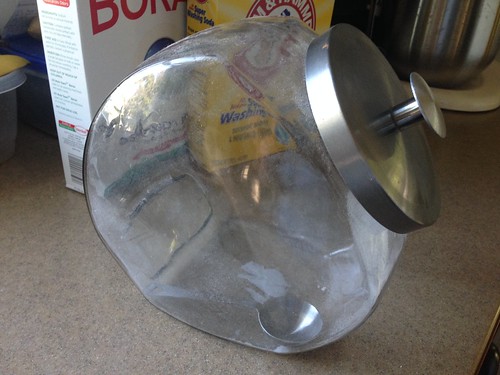
That's my laundry soap jar.  Sadly, it is empty.  I sent Emma downstairs last night to do some more of her giant pile of laundry, and she came back up very quickly, telling me in triumph, "I can't do laundry, there's no soap!"  I could hear the cheering inside her head.

Well.

I have been mixing my own laundry soap for two years now, and it's great.  I did the first batch in May 2013, and then a second batch in May 2014.  The second time around, I left out the baking soda and made up the difference in volume with washing soda/borax, and couldn't tell that it made a speck of difference.  Each of those 9-cup batches lasted us a year, so here we are in May again and it's laundry soap time.

This time around, though, I paused before buying a bar of Fels-Naptha.  Soap... hmmm.  I can MAKE that!  Without fragrance or color or extra chemicals!

So I got out the lard and lye, and mixed up a quick batch of soap.  The other soaps I've made were cold-process batches, where the mixture is not cooked but rather left to sit for 4-6 weeks after molding to allow the soap to harden and fully saponify.

Today, though, I needed to do laundry immediately and couldn't wait 4-6 weeks for curing. So I did this batch as hot-process.

Since this is for laundry soap, I also made this batch with 0% superfat, meaning that all the oil will react with the lye and no oil will be left over at the end.  Normal people-washing soap is usually about 5% superfatted, since having a little un-reacted oil left over is a good thing.  Superfatted soap isn't as harsh and drying, and feels better on your skin. However, you don't want a lot of free oil floating around in a load of laundry, so no superfatting on this batch.

Hot process soap starts out the same as cold process soap: mixing up the lye water and adding it to the liquid fat.  I used 100% lard this time, since it's just for laundry and I didn't want a soap that will be really bubbly in the washing machine.  I mixed with the stick blender until trace.

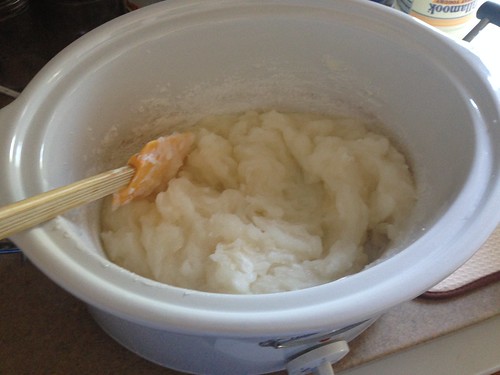
Then the difference comes in.  Hot process soap is cooked to speed up the saponification.  I put it in the crock pot, on low, and let it go until all the lye was reacted (about an hour).  At the end, it sort of looks like Vaseline, translucent and silky.
Untitled

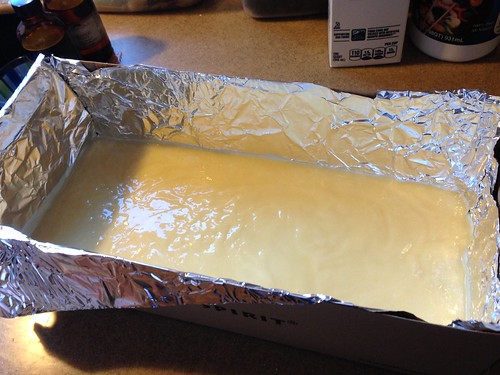
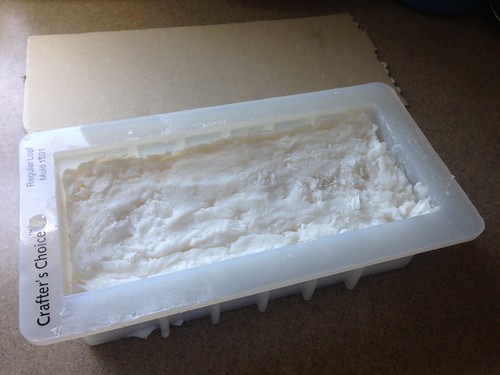
Then I put it in the mold and let it cool down for a couple hours.
Untitled

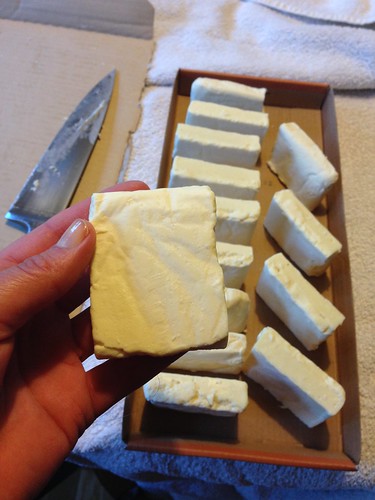
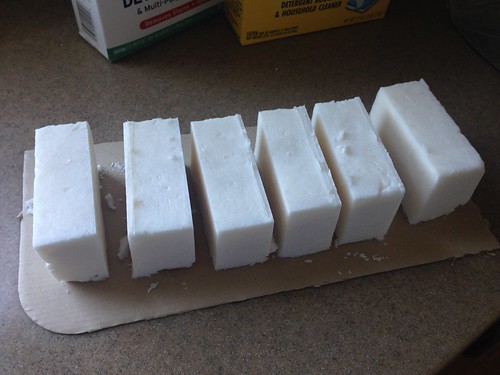
And then I cut it into bars.  This was a two-pound batch, and I cut it into 6 bars of approximately 5.5 ounces each (the same as a bar of Fels-Naptha).  Since this was made by hot-process, the soap is ready to use immediately!  It's still good to let it sit for a while to harden, but the saponification is complete and it won't burn like a cold process soap that hasn't cured long enough.
Untitled

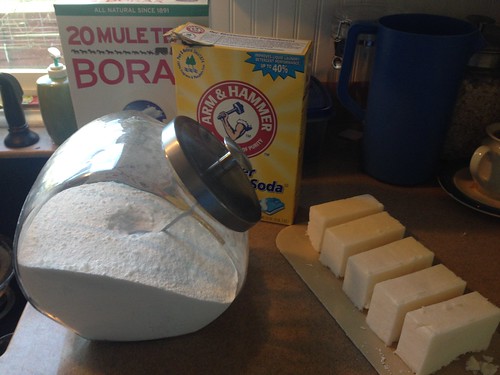
But this is for laundry, so I grated a bar and combined it with the washing soda and borax.  And now I'm set for another year.  Actually, I have enough soap for six years of laundry!
Untitled

Each of my bars of laundry soap costs $1.54 (Fels-Naptha bar = $4.31).  The total cost of this 9-cup batch of laundry soap is $4.41.  That's about $0.03 per load of laundry.

I love being crafty.
Successful laundry soap!

Monday, May 04, 2015

Turmeric soap

You didn't really think there was only going to be one batch of soap, did you?

Turmeric swirl soap

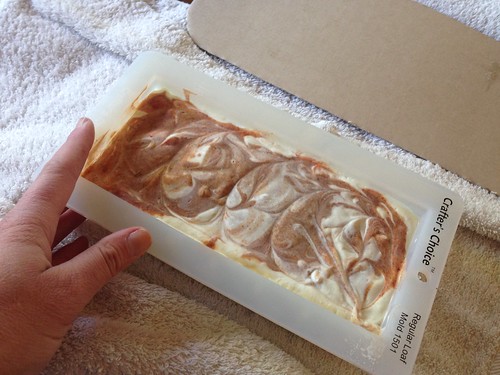
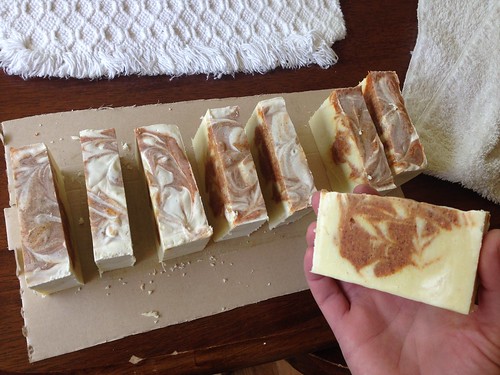
I made this late Friday night, and cut it into bars Sunday morning.  This is a two-pound loaf of olive oil, coconut oil, and lard soap.  I divided the batch before I poured it into the mold, and mixed a teaspoon of turmeric into about a third of the batter.  I poured the white first, then the orange, and gave it a swirl with a chopstick.  The white portion of the batter is scented with rosemary and mint essential oils.

Oh, and also I had to get a soap mold.  Because toys are fun.

Turmeric swirl soap

I'm very pleased with the way this came out.

Monday, April 27, 2015

Chemistry lab

I did a little chemistry experiment yesterday. I investigated the interaction of a strong alkali with two mixed fats, and the saponification resulting from said combination.

I made soap.

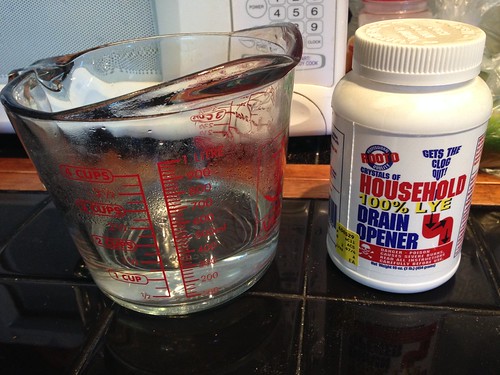
First you dissolve lye (sodium hydroxide) in water. I used 85 g of lye in 225 ml of water. Lye is a very nasty, strong chemical, and it is imperative that you wear gloves and eye protection when handling it. You put the lye into the water, never ever EVER the other way around, or it might volcano up and burn you. It gets VERY hot, VERY fast, all by itself, in addition to being highly caustic and giving off fumes. I did this part of the process outside.

Love those exothermic reactions. Be careful.

Making soap

I had a hard time finding lye in my town, because it’s used to make methamphetamine. None of the supermarkets or big box stores carry it, but I finally found it at a small hardware store.

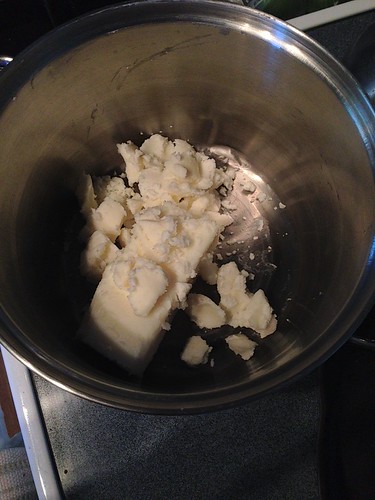
You have to let the lye solution cool- it spiked up to almost 200 F in less than a minute! While it’s cooling, you melt the oils (if necessary). For this batch I used oils which are solid at room temperature: 175g of coconut oil and 425g of lard. Yes, lard. I have never in my life bought a container of lard, but now I have. Apparently it makes good soap. So there you go.

Making soap

When the lye solution and oil are both about 110 F, it’s time to combine them. You carefully pour the lye (no splashing!) into the oils, and stir. I used my spiffy little immersion blender because otherwise I would have been mixing by hand for more than half an hour. I used it in short bursts interspersed with hand mixing. This combines the lye and oil, and the reaction starts.


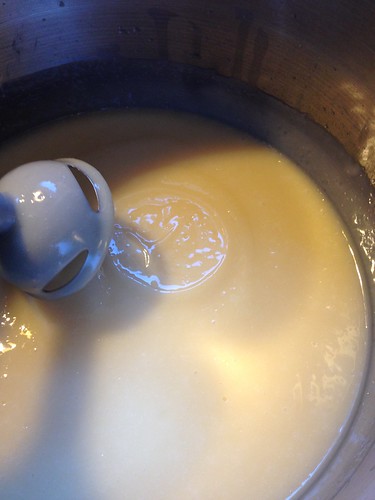
The thing to watch for is “trace.” This is when the mixture starts to look like pudding and will hold the line of a dribble on its surface. You don’t want to mix too vigorously or too fast, because depending on the recipe the mixture might get to trace very quickly and you wouldn’t be able to get it into the mold before it sets up.  Here you can see the outline of the mixer head left in the goop after I lifted it out.  That's trace.

Making soap

It took my soap less than 10 minutes to get to trace, then I quickly blended in some lime and sweet orange essential oils just for fun and poured it into the mold. I have a very high-tech mold, as you can see.

Making soap

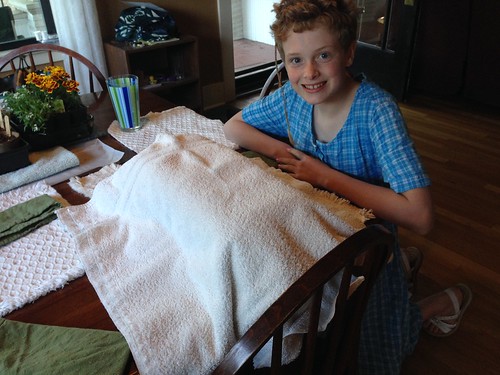
It's just a shoe box lined with aluminum foil with a layer of plastic wrap on top.  You DON'T want the raw soap to come in direct contact with the foil because lye will react with aluminum, eating it away and releasing hydrogen gas.  I used the aluminum liner because it's a pretty flimsy box and I thought it would make the sides more rigid, but I don't think it was necessary and I won't do that next time. Then I wrapped the box in towels for insulation and left it for 24 hours to let the saponification magic work.

Making soap

I unmolded it tonight and cut it into bars. 

Making soap

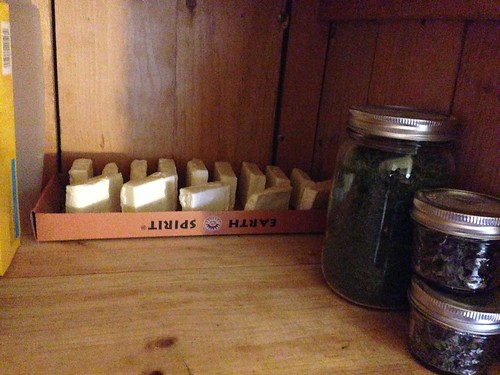
A little wobbly, but rustic is good, right?  Even though the bars are somewhat hard after only a day, they're not ready to use yet.  They need time to allow the saponification process to complete and to fully harden.  So I stood them up in the box lid and stuck it in the back of my cupboard to cure. They'll be ready to use in a month, give or take.

Making soap

This was really easy, and it’s something I’ve always wanted to try. The possibilities of fragrance and additive combinations are virtually endless. I think peppermint soap may be next.  I’m not really a perfumy froo-froo kind of girl -- I tend to buy unscented if it’s an option -- but this was fun!

Sunday, May 05, 2013

So...  let's talk laundry soap.

There are lots of recipes for making your own floating around the web and pinned on Pinterest, and I pinned one myself, intending to try it out.  It was one of the "cooked" ones, where you melt grated bar soap and combine it with the other ingredients and water into a liquid laundry soap.

I've been using commercial liquid laundry detergent for the past 18ish years, because that's what Shaun liked and wanted me to buy. (Which makes no sense, since I was always the one doing the laundry...)  Before that, in college and grad school when I lived alone, I preferred to buy powdered laundry detergent so I wasn't paying for water in the jug or dealing with a drippy measuring cup.  But I digress.

I pinned the recipe, bought the ingredients, and then they sat in the pantry for months because I'm lazy and didn't want to go to all that trouble of cooking up a batch of soap.  It seemed to have a high potential for being messy, and plus where the heck am I going to store five gallons of laundry soap?

I finally realized yesterday that I can go back to powdered laundry soap, because the liquid variety is no longer a requirement in my house!   The ingredients for the DIY powder are the same as for the DIY liquid.  It should work the same, provided it dissolves completely in the washer.

So yesterday, I made a small batch of powdered laundry soap.

DIY laundry soap

Ta Daaaaaa!

Recipes on the web are mostly variations on a theme.  Local water chemistry plays a role in how much of each ingredient you need, but in general it's washing soda, borax, and bar soap, sometimes with baking soda added as well.  All the ingredients were available in my local grocery store.

DIY laundry soap

The recipe I used was:

3 cups washing soda (sodium carbonate)
3 cups borax (sodium borate)
1.5 cups baking soda (sodium bicarbonate)
1 bar Fels-Naptha laundry soap

I grated the soap with the finest disk of my food processor, but it was still more like long curls than powder, so I took off the grating disk and pulverized it further with the regular blade attachment.  My goal was to get it as powdery as possible so it would dissolve faster in the washer (I have a high efficiency (HE) front-loader).  Then I mixed everything together in a jar.  Done.

This took approximately 10 minutes start to finish.  Easy peasy.  The small batch I made yesterday yielded about 9 cups of laundry soap, with a total cost of $8.84.  Unless the clothes are really dirty each load only requires 1 tablespoon (really!), so that amount will wash 144 loads of laundry, for a cost per load of about $0.06.

For comparison, the All Free and Clear liquid I was buying before cost about $0.19 per load.  Mixing up my own is a third of the cost.  Significant savings.

I've done six loads of wash with it so far, and I'm convinced.  It's cheap, it's quick and easy to make, it's phosphate-free, and it works really well.  The only things I may change are to leave out the baking soda since I'm not sure it's really necessary, and to find a bar soap that doesn't have coloring or fragrance. I know I've seen Kirk's unscented castile soap bars here in town, and people have reported good results with that.  The Fels-Naptha has a pleasant but strong fragrance, and though it nearly completely dissipates during line-drying, I'd rather have unscented laundry.  On the other hand, the Fels-Naptha gets out dirt and grease stains really well.  In any case, I'm not going to buy commercial laundry detergent again.