Showing posts with label wool combing. Show all posts

Tuesday, December 19, 2017

Santa came early

Since I had so much fun combing the Lopez Island wool, I've been all inspired to do more.  One thing I've had in my mind for a long time is to be able to efficiently comb fine fibers like merino and alpaca.  The Indigo Hound viking combs that I used on the Lopez Island wool are fabulous for medium and coarser wools, but not great for fine fibers because the tines are just too far apart.  They work, but it takes more passes and leaves more waste.

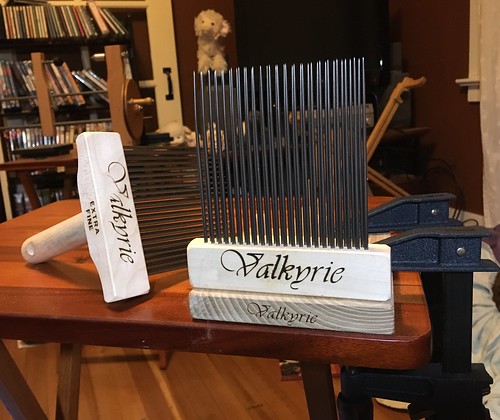
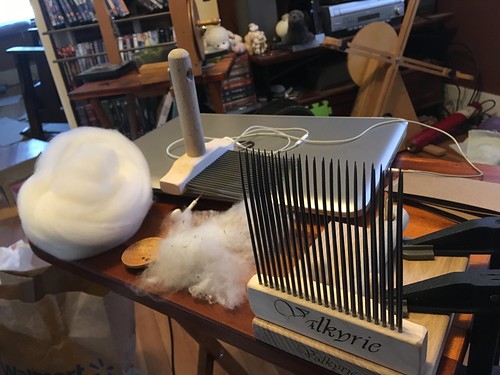
So Santa came early to my house and dropped off a set of Valkyrie extra-fine combs.

Valkrie extra-fine wool combs

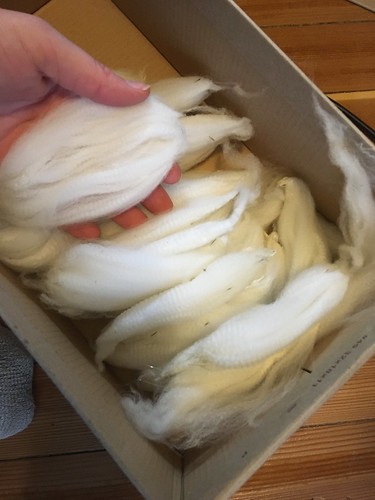
I did the inaugural run with some more of the Australian merino that I used for the test skein on my Bee Hummingbird spindle.  I washed up a bunch more locks into puffy delicious puffs of puffiness.

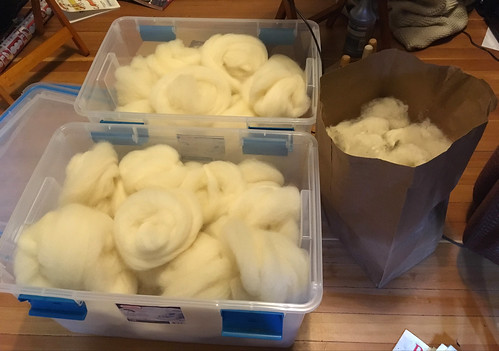
Australian merino (17.4 micron) washed locks

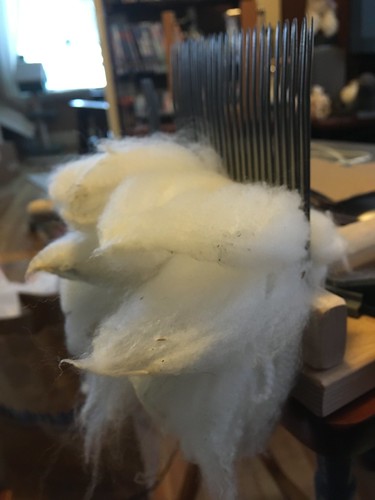
I lashed on 13 grams of locks to one of the combs,

Australian merino (17.4 micron) locks on Vakyrie extra-fine combs

then combed it off with the other,

Australian merino (17.4 micron) on Vakyrie extra-fine combs after one pass

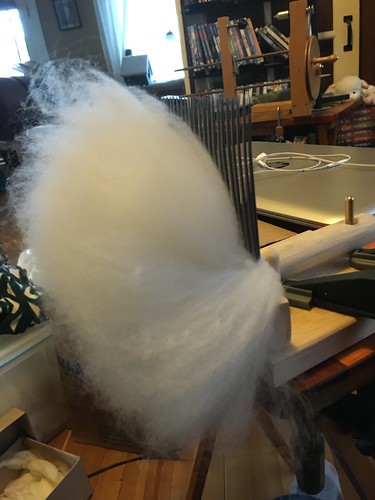
and then combed it back onto the first comb.

Australian merino (17.4 micron) on Vakyrie extra-fine combs after two passes, ready to diz

This wool is so gorgeous.  It's 17.4 micron diameter fiber, which is very fine, and it's so soft and smooth and lustrous.  This is only two passes through the combs, and it's ready to diz off into top.  These combs did an amazing job.

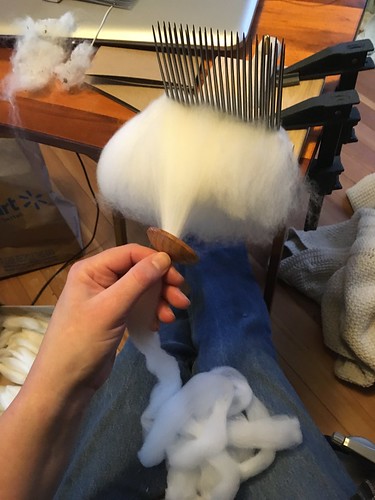
The next step was dizzing.  You pull a little tuft of wool through the hole in the diz, then draft and pull, draft and pull, draft and pull, each time pushing the diz back up toward the comb to pull in the next bit of fiber. The hole in the diz helps keep the diameter of the top consistent. 

Australian merino (17.4 micron) on Vakyrie extra-fine combs, dizzing off the fiber

Here's the finished nest of top- 12 grams of pure fiber bliss and 1 gram of waste fiber, in about five minutes.

Australian merino (17.4 micron) combed on Vakyrie extra-fine combs. 12g of top, 1g of waste.

Ah.  Maze.  Ing.

Monday, December 18, 2017

Half a fleece

Ta Daaa!

Lopez Island wool, all combed!

I finished combing the Lopez Island wool!

The half-fleece weighed 3.0 pounds in its raw, unwashed state.  After washing, it weighed 1.7 pounds.  The finished product is 673 grams (1.5 lb) of combed top and 109 grams (0.2 lb) of waste fiber.

I've never combed a chunk of fiber this big before, and I can't believe it only took two days to wash and three days to comb.  It's also unbelievable how well and how easily combing gets rid of ALL the vegetable matter in a fleece!  It was time well spent, and I really enjoyed it.

The finished top is just beautiful and I will very much enjoy spinning it.  The wool isn't super soft but I think it will combine very well in a sweater with some other San Juan County fiber that I was given way back in 2007 and spun in 2009.

I have a deep, deep stash.

Thursday, December 14, 2017

Processing a fleece

Oh hello, remember me?  I've been playing with fiber.  There's a big pile of spun yarn that is yet to be photographed, but what I want to show tonight is this fleece that I finally got around to processing.

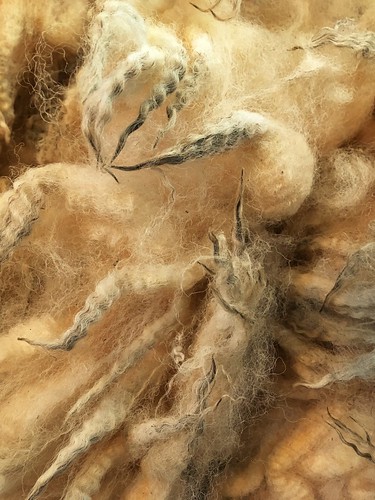
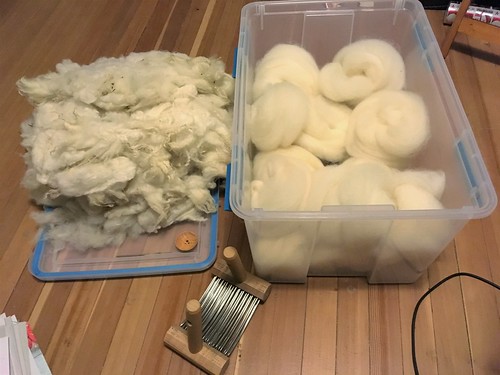
Lopez Island wool, half a raw fleece

This is actually half a fleece, purchased at the 2016 Columbia Gorge Fiber Festival, from a full fleece that I split with a friend.  It's from Lopez Island, Washington, and if I remember correctly it's a mixed breed dominated by Romney and Blueface Leicester, with lesser amounts of East Friesian, Coopworth, Columbia, Dorset, and North Country Cheviot genes in the flock.  It's been sitting in the closet for over a year, and this week was finally its turn to shine.

I washed it in two evenings, just in my kitchen sink in dishpan-sized batches.  It wasn't overly greasy, but the tips were pretty gunked up with hardened lanolin and dirt.

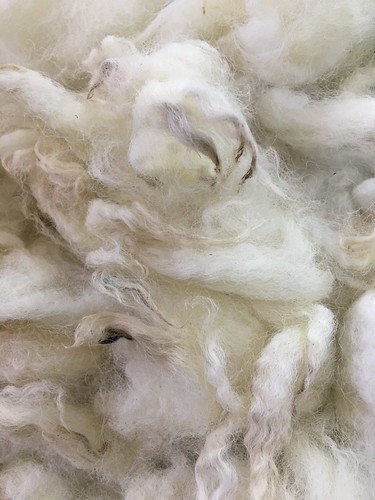
Lopez Island wool, raw

After one hot soapy soak and two hot rinses, the wool became a lovely creamy white and all the grease was out.  Some of the tips were still a little dirty and clumpy, but not too bad.  They opened right up during combing.

Lopez Island wool, washed

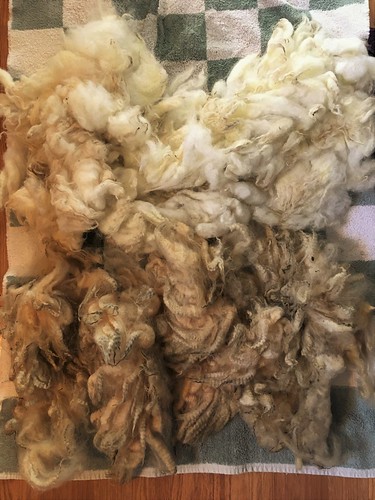
So here's the before and after.  Washed on top, raw on the bottom.  The lighting is wonky on this picture, but trust me, there was a big difference.  The separate shots above are pretty close to the actual color change.

Lopez Island wool, washed on top, raw on the bottom

Once the wool was clean and dry (furnace vents are wonderful for drying wool, if you can keep the cats off), my next step was combing.  You load the wool onto one comb and comb it off with the other, during which all the dirt and vegetable matter (bits of hay, etc.) falls out and the fibers are separated and aligned.

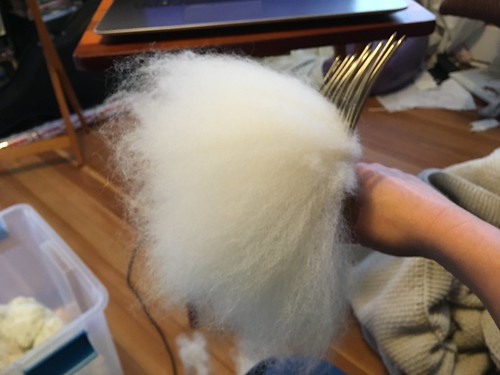
This is after two transfers from comb to comb.  Puffy and delicious.

Lopez Island wool, two passes through the combs

Then I used a diz (the round wooden thing with the holes) to draw the fiber off the comb.  The diz helps make an even-sized rope of fiber called top.  Wind up the top into a little nest, and voila!  Ready to store or spin.

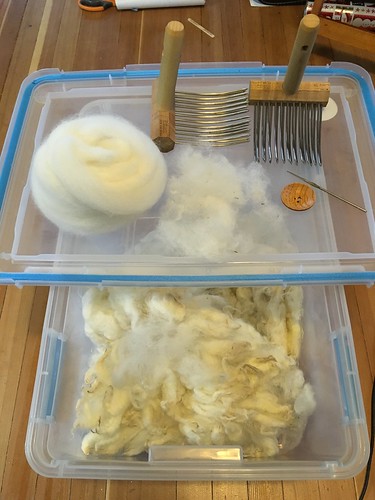
Lopez Island wool, all washed and the first nest combed

That first nest was 20 grams of fiber, with 2 grams of combing waste there to the right.  The waste is all the short bits, neps, vegetable matter, dirt, and other undesirable stuff that the combs remove from the good fiber.  A combing loss of 9% is pretty good- there wasn't a lot of bad stuff to comb out of this fleece.  The finished top is pure spinning bliss.

I combed about half the fiber today, and will get to the rest over the weekend.  I love wool.

Lopez Island wool, halfway combed

Friday, February 13, 2009

A week or so ago, Liz sent me a bundle of wool to take a look at. This was a raw fleece that she bought locally and had processed at a mill, and while the wool was lovely, the preparation was not. It came back to her full of neps. Obviously this was extremely disappointing for Liz, and she emailed me to ask if I had any thoughts about what could be done.

I offered to do a test run through my combs, so she sent me a chunk of the roving. This is a Romney/Merino cross, and is very crimpy and fine. Liz told me the tag from the shepherd says "S/L 4"+/- Virtually NO vegetation in wool. Strong healthy fiber. Soft nice handle. Great color. Consistent in color & crimp. EASY TO SPIN." I would agree with that. The staple length was about 4", it's very soft, and a very interesting color. Sort of a cinnamony apricot gray. Did I mention crimpy? And soft? Definitely more toward the Merino end of the spectrum than the Romney.

And, unfortunately, chock full of neps. I pulled out lots of individual fibers, and they all seemed to be about 4" when held under slight tension, so I don't think the neps were due to a weak spot in the staple. The neps, when teased apart, were mostly long intact fibers. Some had a core of dirt or VM.

I spent a couple evenings this week doing experiments. There are a lot of pictures in this post, but bear with me, they're important for illustrating this experiment.


I'll start from the top left corner. The first piece is the roving in it's unaltered state.


You can see how neppy it is:


This is a terrible thing to happen to a beautiful fleece.

So my first instinct, and the first thing I tried, was combing. I figured that if anything was going to get the neps out, it would be the combs.


It worked moderately well. Unfortunately, there was a lot of waste. It took 5 passes through the combs (Indigo Hound double-row Viking combs) to get most of the neps out, and out of 5 grams of wool, I got 2 grams of top. (Note: my scale doesn't register amounts this small very well, so these weights likely aren't terribly accurate. Let's just say that I lost about half the fiber and call it close.)


It's definitely an improvement. The top is mostly nep-free and will make a better yarn.

I wanted to fully explore the possibilities with salvaging this roving, though, so I also tried using the hand cards (Schacht 208-point cotton cards). I knew that the cards wouldn't remove the neps, but I wanted to see what would happen. I did 6 passes through the cards, and rolled it lengthwise into a cigar, then attenuated it into "top".


Surprisingly, it was also moderately successful. I was really not expecting much from the cards, and was pleasantly surprised to see that some of the neps were "un-nepped." The very fine carding cloth and very gentle brushing seemed to untangle some of the spots and give a slightly smoother product.


There are still neps, but it's an improvement over the original roving.

The last thing I tried that evening was the drum carder. I knew it probably wouldn't be at all successful, but this is for Science, and is an Experiment, and I wanted to know what would happen. So I carded a little batt.


I sent the fiber three times through the carder (Strauch Finest), turning the drum very slowly and steadily so as to avoid having the fibers snap back on themselves as they transferred from the lickerin to the main drum.

This part of the experiment did not pleasantly surprise me at all. It was a completely expected Fail.


The batt is fluffier than the original roving, but that's the only good thing. The neps are still all there, and some were added. NO improvement.

So that was Day 1 of the experiment. My conclusions were that, as expected, combing was the best way to salvage the wool. However, I had a thought as I was working with this roving.

It seemed to me that the wool was not completely clean. It seemed slightly sticky and tacky, and the fibers liked to hold onto their neighbors, then let go with a boing as the crimp overcame the gluey stickiness. Fine wools are prone to this spring-back; that's generally what makes neps. This, however, seemed excessive and the stickiness wasn't helping.

I still had about half the roving left, so I decided to wash it and start over. I used hot tap water and a good squirt of Dawn dish soap, with two hot rinses.


As you can see, the water was very cloudy. You can hardly see the mesh bag through the water. Quite a bit of lanolin came out of this roving. After it was dry, I could feel the difference immediately. The fibers were more amenable to sliding past each other, now.


No real difference in the look of the roving, but a very different feel.


Still neppy. I started at the beginning, with combing.


Same as last time, I did five passes through the combs. I was hoping that the washed roving would give less waste than the unwashed, but it ended up being about the same, about a 50% loss. It was much easier to comb and diz, though.


Then, because I'm thrifty, I decided to see what I could do with the combing waste. There was just so much of it, you see. So I carded it on the hand cards, I think 5 or so passes, and it wasn't horrible. Neppy, yes, but spinnable.

I spun up quick and dirty samples on my little Cascade spindle, just to see what the yarns would look like.


The top one is from the combed top, the bottom is from the carded combing waste. Both were spun laceweight, as that's what I like to spin. The combed top was lovely to spin, and the neps were pretty easy to pick out as I went. It gave a somewhat textured yarn, though probably if I had spun this on my wheel instead of the spindle, it would have been more even. It's pretty, though.

The carded combing waste gave a very textured yarn, as expected. I had to restrain myself from picking out the neps as they passed, which was hard! I don' t think this yarn would wear very well, though maybe if it was spun thicker and had more plies it would be all right. Actually, now that I think about it, these neps would make an interesting textured tweedy yarn if blended with a contrasting colored fiber.

Next, I tried carding the washed fiber on the hand cards.


On the left is a rolag, and the coiled bit is a carderful that was rolled cigar-fashion and attenuated into "top." Both had six passes through the cards. As with the unwashed carding trial, there's definite improvement over the uncarded roving, and I think the washed is better than the unwashed.


I must say, I was really surprised that the hand cards got out some of the neps. I was not expecting that at all.

I also spun one of the rolags on the spindle, as a comparison with the other preparations:


It was an interesting, logical progression. The combed top is the most consistent yarn, followed by the carded rolag, followed by the carded combing waste. It makes sense, as the top has the fewest neps and the carded waste has the most. Spiffy.

The last thing I did was to drumcard the washed roving.


As before, not a good idea. Totally neppified.


I do think it's not quite as bad as the drumcarded unwashed fiber, though. It's a bit hard to compare the two, since the washed batt is thicker than the unwashed batt. I think perhaps it just maintained the same number of neps that were in the original roving, without adding more. Nice and fluffy, though.

My Conclusions:

1) I think this roving was inadequately washed and/or rinsed at the mill, which led to residual stickiness and the creation of many more neps than should have been formed during carding. The carding machine could also have been set to run too fast for this fine and crimpy wool.

2) Combing is the best solution to get out the neps and produce a smoother yarn.

3) Combing will result in a LOT of waste fiber.

4) It is possible to re-card the combing waste, for a textured yarn, preferably part of a blend for added stability.

5) Hand cards will smooth out the neps a bit, but you have to be very gentle. Very fine cards are probably best, and it takes quite a few passes for each little batch.

6) Drum carding the roving is not helpful, except to fluff it up.

What would I do with it? Two options:

1) Spin it as-is, neps and all, into fine singles, as even as possible but not obsessing about it, and make a 3-ply (or more) yarn. When plied, the bumpiness would tend to even out, as seen in this quick 3-ply spindled sample, a heavy laceweight:


It's textured, but not excessively, and I didn't even pick out any neps as I was spinning. Really not too bad as long as you don't expect a perfectly even yarn. The neps will tend to work their way out, though, and this yarn may be prone to pilling.

2) For a more hard-wearing yarn I would comb it to get as much good fiber out as possible, and spin a fairly thin worsted-technique singles, given the fineness of the fiber. I would definitely make a multi-ply yarn, to help prevent future pilling. I would then take the combing waste, dye it lots of bright colors and card it into a medium-dark wool for a fun tweedy blend.

This was a really interesting puzzle to work through. I enjoyed it!

Tuesday, January 20, 2009

I spent lots of time the over the past few days doing woolly things. I do love a fiber-filled weekend! I finished picking the rest of the uncarded sweater wool on Saturday and Sunday, but discovered along the way that several batches needed another wash. Fine wools are just so greasy, and I guess I tend to be conservative when I wash wool. I'd rather be careful and do an extra wash later down the line, than risk felting the wool. As it is, I practically have to tie my hands down when I'm washing wool, because I can't. stop. poking. at. it. Criminy, just set the timer and walk away, Sue... I would like to state, for the record, that no part of Buttercup's or Herkel's fleece felted!

I've been considering getting some Power Scour to try out. I've heard good things about it on Ravelry, and think maybe I'll give it a try. I currently use Dawn to wash wool, and am happy with the results, but after washing Buttercup I realized that even with the concentrated Dawn, it takes a LOT of soap to get a finewool fleece clean. The hype reviews I've read indicate that Power Scour gives comparable results to Dawn, doesn't take as much, and it is better suited to lower water temperatures. Even though I don't usually add any boiling water to the basin when I wash fleece with Dawn, if Power Scour gives the same results in my hottest tap water, using much less product, I'm willing to give it a go.

Those five batches weren't super-greasy, but enough to leave a pretty good film on my hands while I was picking, and I didn't want that gunking up my carder. Plus, VM falls out better if the wool is squeaky clean. So anyway, I finished picking everything Sunday night, and then washed the five batches that needed it.Last night and tonight, I got the rest of Buttercup's wool carded through the first time. What a glorious sight in my dining room!


Now I'm ready to blend!

Backing up a bit to recap, last Saturday was a majorly fibery day. One thing I did was to start spinning the brown Border Leicester/Romney wool. It's drafting like a dream now, after carding, and should be lovely yarn for an outerwear garment. I think I have four batts left to spin, then will 3-ply the singles and add the yarn into the pile of odds and ends that may eventually become another sweater.


After two batts of that were spun, and I picked a couple batches of the Buttercup wool, I broke out the combs and made a few nests of Herkel's wool.


I'll work through the 150 grams of wool I reserved for the froghair shawl as I get a chance. There's no rush on this, since I'm not even done spinning the first 100 grams I combed. This is definitely a long-haul project.

Then, just for kicks, I carded up one lock of Herkel's wool on my hand cards, and spun the resulting rolag on my Cascade spindle. This was the first time I've tried wool on both the hand cards (only done cotton before) and that spindle (only used silk before). The results were quite lovely:


That little sample skein weighs barely 1 gram (my scale doesn't register amounts that small very well, and fluctuated between "0" and "1"), and contains 28 yards. That works out to about 12,700 yards per pound, 2-ply, and roughly 70 wpi. It's very soft and squishable.


Apparently, there's nothing you can do to Herkel's fleece to make it look bad. Flick it, comb it, card it, use a wheel, use a spindle - it's all good....

Sunday, April 27, 2008

The problem with getting behind on things I want to blog about is that I get so far behind, and then I become paralyzed and feel like I can't blog anything until I blog that thing I wanted to blog about, so no blogging gets done at all. Blog blog blog, what a funny word.

I have weaving, spinning, and dyeing that I want to show off, Emma's first school play, several blog-worthy rants while at the gym, thoughts on laundry and lawnmowing and Earth Day (Every Day), my "garden" this year, and other things I can't think of at the moment. Probably I won't get to everything, even in multiple posts.

Let's start with spinning and dyeing, shall we? I am participating in the Sheep-to-Shawl event at the San Juan County Fair again this year. I just love that fair, all my spinning friends are there, and it's just a really meaningful event to me. I am traveling from La Grande, Oregon to Friday Harbor, Washington for the express purpose of going to the Fair and Sheep-to-Shawl. Well, and to pick up Shaun, who is spending six weeks doing research at the Friday Harbor Labs this summer, ending right around Fair-time. But I was going to the Fair, regardless of whether Shaun was spending the summer doing research there. The timing of his research stay just worked out really well. Unfortunately, Emma and I probably won't be able to spend the summer at the Labs again this year. It's expensive for one thing, to live there and still pay rent here. I am also hoping to be working again this summer, though I haven't heard anything yet.

Anyway. Sheep-to-Shawl. I got to design the shawl this year, and will be weaving it at the Fair! I played around with colors and patterns a bit over the winter, and did a couple little samples. Which I promptly lost. Seriously, I have no idea where they went. I looked everywhere. So, in the interest of being able to actually communicate the design to the other members of the S2S team, I had to do them over. That's what I spent a couple days last week doing.

I wanted the warp and weft to contrast, with the warp dyed and the weft natural white. Both will be a blend of 70% dyed Romney/Border Leicester wool and 30% undyed alpaca. I dyed a small batch of wool (all I have on hand that's not dyed is Rambouillet x Cormo, but this is only a color sample so that's OK) on Wednesday, and combed and spun it Thursday, blending the alpaca in with the combs.


Yum. I did this by weighing out 30% of the wool weight in alpaca, then splitting both into rough thirds before combing. I didn't try to get the color perfectly even between comb loads, since I wanted a somewhat marled yarn.


While the finished yarn is lovely, it wasn't quite the color I was going for. I wanted a mossy green, and this is a little too blue. So I dyed up another handful of wool on Friday and tried again.

Now, let me preface this by saying I have had a really hard time with my dyes this week. Nothing set properly the first time through, the dye colors broke unexpectedly, and nothing came out the way I wanted. It was quite frustrating. I wonder if the town has been fiddling with the water treatment plant?

This is the green wool I finally ended up with. The first dyebath (the perfect mossy green, I thought) broke and produced wool that was brown, teal, bright sky blue, and a little green. Hideous. The brown was OK and parts of the green, but the blue had to go. So I overdyed it with the barest smidge of yellow, and that evened it out enough that I thought it would work. As you can see, there's still some blue and that chartreuse green is way brighter than I wanted, but at that point I was fed up and just wanted to SPIN ALREADY.


I added the white alpaca and combed it three times, and what do you know?


The perfect mossy green.


This is pretty much exactly what I was aiming for.


I was completely skeptical until the second time through the combs, when the color started to blend. Fiber work never ceases to amaze me. I guess I should have somewhat expected this, based on the clown wig purple I blended a while ago, but still...

(I love my combs, by the way.)

Surprisingly, the Rambouillet x Cormo was pretty much the same staple length as the alpaca, which worked out well for the combing. I though it was much shorter at first, since after the washing (three years ago in Friday Harbor) and dyeing, each lock was a bit shriveled. They opened up and stretched out well, played nice with the alpaca, and made a lovely yarn.


So, so, so soft. And BOINGY!! I must make more of this yarn.

In other dyeing news, I did up some more laceweight for my shop.


1. Frosted Plum, 2. Seaglass, 3. Parsley, 4. Bayberry

These were part of the frustrating dye experience last week. The yarn that I ended up calling "Frosted Plum", in particular, was supposed to be dark red, pink, and rich brown. It looked great after I painted it and wrapped it for steaming. During the heating, though, it somehow became green, blue, yellow, teal, purple, and maroon. It looked like a vomitous rainbow. I really should have taken before and after pictures, because it would have been really funny if I wasn't so upset at ruining all that lovely yarn. However, I knew that overdyeing solves a lot of mistakes, and violently threw plunked the yarn into a kettle of purply-black dye. You see the results. One of my favorite skeins to date.

Thursday, April 10, 2008

I got out the wool combs again today, to try out some alpaca I washed yesterday. This fiber is some that I bought off eBay last November, for a ridiculously low price-- $3.00 for 2 pounds of raw fiber, if I remember correctly. I was somewhat skeptical of what the quality would be, given the price, but couldn't pass up the pretty picture. It looked nice, and I figured that even if it turned out to be poor quality, I was only out three bucks.

I was pleased with it when I got the box, but then got sidetracked and put it away until now. I was even more pleased after I washed 6 ounces yesterday. I was going to wash more, but we were stuffing the mesh bags outside (because of all the dust in the fiber) and were chased inside by a sudden violent hailstorm!

It was very dusty, but washed up bright white with one soapy soak and one rinse. It's quite soft, the staple length is about 4", and there isn't too much VM. After three passes through the combs, it's lovely.


The only minor problem I have found is the amount of guard hair in parts of it, and even that isn't too big of a deal. I was initially going to leave it in, because it's quite pretty (for guard hair). It's bright white and very shiny and sparkly, but it's just a bit too coarse and detracts from the silky softness of the rest of the fiber.

So, I'm picking it out as I go. I pulled out most of it as I was packing the mesh bags for washing, then got the rest as I loaded the combs. It's fairly easy, since the guard hairs are longer than the rest, as well as shinier and not crimped.


I did 10 combfuls today, half the washed fiber, and tomorrow I hope to finish the rest.