Showing posts with label carding. Show all posts

Saturday, December 31, 2011

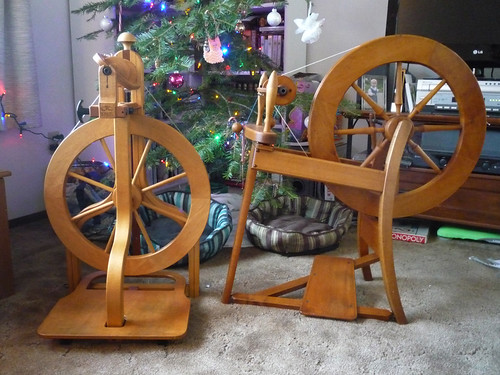
Isn't this a lovely sight?

Matchless and Traditional

I must say, I had forgotten that the Traditional has a larger drive wheel than the Matchless.  It's only a 2.5" difference (22" vs 19.5"), but that combined with the inherently larger footprint of a Saxony wheel makes the Matchless seem so much smaller by comparison.

I finished the first bobbin of superfine merino I started spinning after I repaired my wheel, and decided to spin one of my Christmas bundles of fiber.  This is some gray wool that my dad got for me- he and Emma took a drive down to the yarn store in Baker City (45 minutes south) the first day he was here, and picked out this wool from him and some raw alpaca fiber from Emma.  (This was completely unprompted by me!)

The wool came in a 250 gram bump of carded roving, and I think it had been in that form for a while.  I could tell that it was nice wool, but it was sticky, very compacted, and didn't draft well.  It wasn't felted, but it wasn't really spinnable as is.

I divided the roving into 50 gram pieces (one carder load), and washed them in mesh bags.  A little hot water, soap, and rinsing, and the roving came out unstickified and much easier to draft.  I sent it through the carder once, and it became beautiful and puffy and delicious.

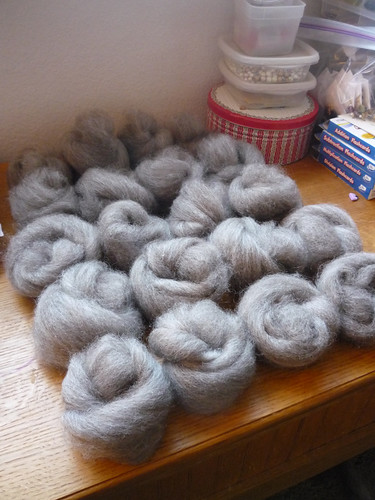
gray mystery wool

Then I stripped each batt into four pieces, wound them up into nests to avoid flyaways, and I'm ready to spin!

gray mystery wool

I was not at all disappointed that I had to go through the extra steps of washing and re-carding this roving.  It gave me a chance to use my carder!

I don't know for sure what kind of wool it is. The tag that came with it said "New Zealand carded sliver- light gray", so that wasn't terribly helpful.  It definitely isn't Merino, which is the first thing most handspinners think of when faced with something labeled "New Zealand wool";  I'm thinking it's something more along the lines of Romney, which is another very common New Zealand breed.  This isn't next-to-the-skin-soft wool, but it will make great sweater yarn. It has a nice luster, and as long as I don't overtwist it, it's reasonably soft.

I spun 8 of the 20 nests this afternoon, about 100 grams and a mostly full bobbin.  I'm loving my newly repaired wheel- it's so quiet now.

Friday, February 19, 2010

I wove off another set of bookmarks last week. This was the purple silk warp I dyed in January, along with some lighter purple silk to use as weft.


The one on top shows the lavender weft, in the sections on the ends. The rest of these have all white weft. There were two other bookmarks from this warp, which used the lavender weft, but I don't have pictures of them since they have already left my house...because...

I recently put some of my work in a gallery of local artists here in La Grande, the Blue Turtle Gallery. In a gallery! Me! In a completely uncharacteristic display of bravery, I walked into the gallery and asked the owner if she would be interested in displaying my textile creations. She was quite enthusiastic, and we set up an appointment for me to show her my work the next day. She said she's been looking for a textile artist to add to the gallery for a while, and was very impressed with what I brought to show her. So now I have woven, knit, and crochet items for sale in a gallery. Eep!

One last thing to report:


I am slowly succeeding in my plan to take over the entire house with fiber fun. This is what used to be the computer desk/bookcase in the dining room, formerly occupied by old textbooks and all our assorted clutter, and sometimes used by Shaun to work on his computer.

The bookcase part of the desk just sits on top and isn't attached, and last weekend we realized that hey, we could take that off and suddenly there's all this SPACE! We moved the bookcase part of the desk out to the utility room counter, cleared the clutter, and now I have a carding station!

Plus, the dining table is now available for actual dining, since the carder no longer resides on it.

I love having a dedicated spot for the carder, and it feels very productive to have everything set up and ready to go. Feel like carding a batt or two? Go for it! Right now I have two large bins of alpaca fleeces under the desk, which I plan to work through this spring and summer. The small box in the middle is for carding waste. On top of the counter, right to left: the carder; carding tools (flicker, batt picker, etc); a bin of "add-ins" like silk, bamboo, mohair, sparklies, etc.; bundles of hand dyed bluefaced leicester top ready for blending; a scale; a bin of finished batts; and my "office", with a desk organizer (pens, tape, stapler, etc) and the printer (with trays in the stand for paper storage).

There's plenty of space to work with the batts, pulling them apart for additional blending passes, and there's space to plug in my computer when I need to print labels or receipts. The dining table is close by if I need additional space for photographing and packaging batts.

It's working very well so far.

Thursday, March 12, 2009

Remember the blue/green/purple top I recently dyed? Well, it grew up and became a couple lovely batts. Introducing the inaugural run of batts for sale at my Etsy shop:


Clockwise from the top left, they are:
  • Snow Shimmer (75% bluefaced leicester, 20% silk)
  • Spindrift (98% superwash merino, 2% Icicle (nylon sparklies))
  • Seamist (80% superwash merino, 20% silk)
  • Latte (50% natural white bluefaced leicester, 50% natural brown bluefaced leicester)
Each batt is about 50 grams (1.8 oz). These were so fun to make. The BFL, a fiber I've not worked with before, is quite nice. Soft, but not cottony soft, not too fine or slippery, and with a good staple length and luster. I see why people recommend it for beginning spinners. The addition of the silk in the Snow Shimmer batt gives it a lovely shine and softness.

For the Latte batt, I took equal amounts of each kind of BFL and split them into thirds. I carded one third of each together to give a medium brown blended mini batt, which I removed from the carder. Then I carded the dark brown through and left it on the carder, carded the medium brown blend again and left it on the carder, and finally carded the white on. This gave a layered blended batt, with a gradient of colors from white to brown. I like it.


Recarding the dyed merino top was a smashing success. Soft soft soft batts, and the colors blended beautifully. I only sent them through once, alternating layers of the merino with toploaded silk or Icicle. I have a bit of the top left over, and am going to card up a mini batt for myself. Just because.

I love the way the blue and green combined into an aquamarine color. Most of the purple spots from the top went into the Spindrift batt, and it looks fabulous with the Icicle.


And the Seamist? Really, you just can't go wrong with merino and silk.

Monday, March 09, 2009

TA DA!


The carding is done! Thirty batts, made up of fifteen colors, carded three times: once as separate colors, twice to blend.


All together, the batts weigh 3.0 pounds, fluffily fill two plastic containers totaling 114 quarts, and cover a tabletop measuring 13.5 square feet.


Overall, I'm quite pleased at how consistent the batts are. There is some surface variation (streaks of color), but if you squint at them, they all look pretty much the same hue and value. I took these pictures and am writing this post immediately after finishing the last batt (notice the time of this post), so the middle of the night lighting leaves something to be desired and the color is a bit off, but you get the idea. Hopefully the consistency carries through to the yarn.

One other thing I did this week was to spin another experimental sample skein, just out of curiosity.


The original sample is on the top, the new one on the bottom. What I did this time was to take one sixth of a batt after only one blending pass through the carder, when it was at the layered stage, and spin it like I did the first sample, including chain plying. I just wanted to see how the layered batt would spin up.

The outcome was pretty much as you would expect it to be. The colors were more distinct, less blended, and the red especially was very noticeable.


Granted, if this were a true 3-ply rather than chain plied, it wouldn't have been quite so obvious, but even so, the singles themselves often had long stretches of nearly solid red or chartreuse. It's a pretty yarn, but not what I want for my subtle heathered sweater yarn.

So now I know.

Monday, March 02, 2009

Well, it's Monday again. Also, it's March. Is it just me or are the weeks of 2009 just flying by? I actually got a lot accomplished at work today, most of Mount Laundrypile folded and put away, the bathrooms cleaned, and am cautiously optimistic that this week is going to be better than last week (which was less than steller for many reasons, none of which were really that terrible by themselves, but when combined led to what seemed like an insurmountable wall of frustration and grumpiness).

I binged on the spinning over the weekend, accomplishing what may be my personal best to date in terms of volume and time:


This is contract spinning for Tanglewood Fiber Creations; 16 ounces of cashmere/silk and 16 ounces of camel/silk. Two full pounds of singles for sockweight yarn. Spun in ~10 hours over three days. Each two ounce ball took 35-40 minutes.

I love it when the fiber drafts as easily as these preparations did. Long draw rocks.

I've also been carding, and have tipped over the halfway point on the green Corriedale batts. I have 16 of 30 done and ready to spin.


The sweater carding may possibly be done by next weekend!

Saturday, February 21, 2009

I was finally, finally able to get back to working on my sweater wool this weekend. Has it really been a full month since I had that lovely table full of carded batts? The first thing I had to do was to divide up all the single-color batts and recombine them for the blended batts. Honestly, I think this step was the sticking point for why I haven't worked on this since I got everything carded the first time. The logistics of managing all that recombining were a bit intimidating.

On to blending! I have 1380 g (3.0 lb.) of washed, dyed, once-carded wool, in 15 colors; a total of 30 batts. Each batt worked out to about 45-55 grams, which is a workable amount for the carder, so I wanted to end up with 30 blended batts as well. I needed to split each batt into 30 pieces.

I was originally going to do this by weighing each batt, doing the division, and weighing out each piece. That quickly went out the window, for fiddliness and because my scale doesn't do tenths of a gram.

Instead, I split each batt down the middle, split each half in thirds, and pulled each sixth into five pieces.


It was easy to do, and the batts were carded well enough that doing it this way was "close enough" to even. The resulting 30 chunks of wool went into 30 separate grocery bags. (Please don't hate me for the shocking number of plastic bags I found in my cupboard. I'm horrible at remembering to bring my canvas bags to the grocery store. I promise I'll do better - I'm quite embarassed by this plethora of plastic! When I bike to the store, I bring my own bags/backpack; it's those spur of the moment grocery stops when I'm in the car that do me in. I should just leave the canvas bags in the car, and remember to put them back there after unpacking the groceries.)

Anyway - 30 separate piles of wool. This is what my living room looked like after all the batts had been divvied up.


Each bag had its handles tied and went back into the big box, so the wool chunks wouldn't fall out and get mixed up. By this point, it was about 1:30 am on Friday night/Saturday morning, and I should have gone to bed. I didn't, though. I kept one bag of wool tufts out and had to see what it looked like carded. Hee hee! I just couldn't go to bed without seeing what the blend looked like.

This jumble of tufts:


turned into this batt after one pass through the carder:


I layered the colors onto the carder in order, first all the greens, then the teals, then chartreuse, then red, then brown. It came off the carder a lovely puffy layered rainbow.


That's pretty, but I want a more homogeneous blend for this yarn. So I split the batt lengthwise into four pieces:


pulled off chunks, attenuated them a bit, and sent everything through again. After the second pass through the carder, I had this batt:


Now that's what I'm talking about! The colors aren't completely blended into mud, but overall the effect is even. Uniformly streaky, I guess. Every section of the batt has every color, at some point in its thickness.


The wool carded up beautifully, without neps (yay!) or clumps. Fluffy, puffy, softy, lofty; this is pretty wool. I'm very happy with the blending. I was going to do a third pass, but that would have blended it too much. I want to be able to see the sparks of the accent colors in the finished yarn.


By this time it was 2:00 am. Like a good little girl, I rolled the batt up, put it in the storage tub, and went to bed.

This morning, I tore off one sixth of the batt to spin a test skein.


Love love LOVE it! This is pretty much the exact yarn I was aiming for. This sample skein is chain-plied, but the final yarn will be a true 3-ply. Other than that, it's just right.


This sample is:

28 yards
8 grams (0.2 oz)
10 wpi
1587 ypp

I spun this semi-worsted, with a forward draw from the end of the strip of batt and very lightly smoothing in the twist, but also allowing the twist to enter the drafting triangle. It's very lofty and elastic.


This is so incredibly satisfying, to go from a raw fleece to that yarn.

Friday, February 13, 2009

A week or so ago, Liz sent me a bundle of wool to take a look at. This was a raw fleece that she bought locally and had processed at a mill, and while the wool was lovely, the preparation was not. It came back to her full of neps. Obviously this was extremely disappointing for Liz, and she emailed me to ask if I had any thoughts about what could be done.

I offered to do a test run through my combs, so she sent me a chunk of the roving. This is a Romney/Merino cross, and is very crimpy and fine. Liz told me the tag from the shepherd says "S/L 4"+/- Virtually NO vegetation in wool. Strong healthy fiber. Soft nice handle. Great color. Consistent in color & crimp. EASY TO SPIN." I would agree with that. The staple length was about 4", it's very soft, and a very interesting color. Sort of a cinnamony apricot gray. Did I mention crimpy? And soft? Definitely more toward the Merino end of the spectrum than the Romney.

And, unfortunately, chock full of neps. I pulled out lots of individual fibers, and they all seemed to be about 4" when held under slight tension, so I don't think the neps were due to a weak spot in the staple. The neps, when teased apart, were mostly long intact fibers. Some had a core of dirt or VM.

I spent a couple evenings this week doing experiments. There are a lot of pictures in this post, but bear with me, they're important for illustrating this experiment.


I'll start from the top left corner. The first piece is the roving in it's unaltered state.


You can see how neppy it is:


This is a terrible thing to happen to a beautiful fleece.

So my first instinct, and the first thing I tried, was combing. I figured that if anything was going to get the neps out, it would be the combs.


It worked moderately well. Unfortunately, there was a lot of waste. It took 5 passes through the combs (Indigo Hound double-row Viking combs) to get most of the neps out, and out of 5 grams of wool, I got 2 grams of top. (Note: my scale doesn't register amounts this small very well, so these weights likely aren't terribly accurate. Let's just say that I lost about half the fiber and call it close.)


It's definitely an improvement. The top is mostly nep-free and will make a better yarn.

I wanted to fully explore the possibilities with salvaging this roving, though, so I also tried using the hand cards (Schacht 208-point cotton cards). I knew that the cards wouldn't remove the neps, but I wanted to see what would happen. I did 6 passes through the cards, and rolled it lengthwise into a cigar, then attenuated it into "top".


Surprisingly, it was also moderately successful. I was really not expecting much from the cards, and was pleasantly surprised to see that some of the neps were "un-nepped." The very fine carding cloth and very gentle brushing seemed to untangle some of the spots and give a slightly smoother product.


There are still neps, but it's an improvement over the original roving.

The last thing I tried that evening was the drum carder. I knew it probably wouldn't be at all successful, but this is for Science, and is an Experiment, and I wanted to know what would happen. So I carded a little batt.


I sent the fiber three times through the carder (Strauch Finest), turning the drum very slowly and steadily so as to avoid having the fibers snap back on themselves as they transferred from the lickerin to the main drum.

This part of the experiment did not pleasantly surprise me at all. It was a completely expected Fail.


The batt is fluffier than the original roving, but that's the only good thing. The neps are still all there, and some were added. NO improvement.

So that was Day 1 of the experiment. My conclusions were that, as expected, combing was the best way to salvage the wool. However, I had a thought as I was working with this roving.

It seemed to me that the wool was not completely clean. It seemed slightly sticky and tacky, and the fibers liked to hold onto their neighbors, then let go with a boing as the crimp overcame the gluey stickiness. Fine wools are prone to this spring-back; that's generally what makes neps. This, however, seemed excessive and the stickiness wasn't helping.

I still had about half the roving left, so I decided to wash it and start over. I used hot tap water and a good squirt of Dawn dish soap, with two hot rinses.


As you can see, the water was very cloudy. You can hardly see the mesh bag through the water. Quite a bit of lanolin came out of this roving. After it was dry, I could feel the difference immediately. The fibers were more amenable to sliding past each other, now.


No real difference in the look of the roving, but a very different feel.


Still neppy. I started at the beginning, with combing.


Same as last time, I did five passes through the combs. I was hoping that the washed roving would give less waste than the unwashed, but it ended up being about the same, about a 50% loss. It was much easier to comb and diz, though.


Then, because I'm thrifty, I decided to see what I could do with the combing waste. There was just so much of it, you see. So I carded it on the hand cards, I think 5 or so passes, and it wasn't horrible. Neppy, yes, but spinnable.

I spun up quick and dirty samples on my little Cascade spindle, just to see what the yarns would look like.


The top one is from the combed top, the bottom is from the carded combing waste. Both were spun laceweight, as that's what I like to spin. The combed top was lovely to spin, and the neps were pretty easy to pick out as I went. It gave a somewhat textured yarn, though probably if I had spun this on my wheel instead of the spindle, it would have been more even. It's pretty, though.

The carded combing waste gave a very textured yarn, as expected. I had to restrain myself from picking out the neps as they passed, which was hard! I don' t think this yarn would wear very well, though maybe if it was spun thicker and had more plies it would be all right. Actually, now that I think about it, these neps would make an interesting textured tweedy yarn if blended with a contrasting colored fiber.

Next, I tried carding the washed fiber on the hand cards.


On the left is a rolag, and the coiled bit is a carderful that was rolled cigar-fashion and attenuated into "top." Both had six passes through the cards. As with the unwashed carding trial, there's definite improvement over the uncarded roving, and I think the washed is better than the unwashed.


I must say, I was really surprised that the hand cards got out some of the neps. I was not expecting that at all.

I also spun one of the rolags on the spindle, as a comparison with the other preparations:


It was an interesting, logical progression. The combed top is the most consistent yarn, followed by the carded rolag, followed by the carded combing waste. It makes sense, as the top has the fewest neps and the carded waste has the most. Spiffy.

The last thing I did was to drumcard the washed roving.


As before, not a good idea. Totally neppified.


I do think it's not quite as bad as the drumcarded unwashed fiber, though. It's a bit hard to compare the two, since the washed batt is thicker than the unwashed batt. I think perhaps it just maintained the same number of neps that were in the original roving, without adding more. Nice and fluffy, though.

My Conclusions:

1) I think this roving was inadequately washed and/or rinsed at the mill, which led to residual stickiness and the creation of many more neps than should have been formed during carding. The carding machine could also have been set to run too fast for this fine and crimpy wool.

2) Combing is the best solution to get out the neps and produce a smoother yarn.

3) Combing will result in a LOT of waste fiber.

4) It is possible to re-card the combing waste, for a textured yarn, preferably part of a blend for added stability.

5) Hand cards will smooth out the neps a bit, but you have to be very gentle. Very fine cards are probably best, and it takes quite a few passes for each little batch.

6) Drum carding the roving is not helpful, except to fluff it up.

What would I do with it? Two options:

1) Spin it as-is, neps and all, into fine singles, as even as possible but not obsessing about it, and make a 3-ply (or more) yarn. When plied, the bumpiness would tend to even out, as seen in this quick 3-ply spindled sample, a heavy laceweight:


It's textured, but not excessively, and I didn't even pick out any neps as I was spinning. Really not too bad as long as you don't expect a perfectly even yarn. The neps will tend to work their way out, though, and this yarn may be prone to pilling.

2) For a more hard-wearing yarn I would comb it to get as much good fiber out as possible, and spin a fairly thin worsted-technique singles, given the fineness of the fiber. I would definitely make a multi-ply yarn, to help prevent future pilling. I would then take the combing waste, dye it lots of bright colors and card it into a medium-dark wool for a fun tweedy blend.

This was a really interesting puzzle to work through. I enjoyed it!

Tuesday, January 20, 2009

I spent lots of time the over the past few days doing woolly things. I do love a fiber-filled weekend! I finished picking the rest of the uncarded sweater wool on Saturday and Sunday, but discovered along the way that several batches needed another wash. Fine wools are just so greasy, and I guess I tend to be conservative when I wash wool. I'd rather be careful and do an extra wash later down the line, than risk felting the wool. As it is, I practically have to tie my hands down when I'm washing wool, because I can't. stop. poking. at. it. Criminy, just set the timer and walk away, Sue... I would like to state, for the record, that no part of Buttercup's or Herkel's fleece felted!

I've been considering getting some Power Scour to try out. I've heard good things about it on Ravelry, and think maybe I'll give it a try. I currently use Dawn to wash wool, and am happy with the results, but after washing Buttercup I realized that even with the concentrated Dawn, it takes a LOT of soap to get a finewool fleece clean. The hype reviews I've read indicate that Power Scour gives comparable results to Dawn, doesn't take as much, and it is better suited to lower water temperatures. Even though I don't usually add any boiling water to the basin when I wash fleece with Dawn, if Power Scour gives the same results in my hottest tap water, using much less product, I'm willing to give it a go.

Those five batches weren't super-greasy, but enough to leave a pretty good film on my hands while I was picking, and I didn't want that gunking up my carder. Plus, VM falls out better if the wool is squeaky clean. So anyway, I finished picking everything Sunday night, and then washed the five batches that needed it.Last night and tonight, I got the rest of Buttercup's wool carded through the first time. What a glorious sight in my dining room!


Now I'm ready to blend!

Backing up a bit to recap, last Saturday was a majorly fibery day. One thing I did was to start spinning the brown Border Leicester/Romney wool. It's drafting like a dream now, after carding, and should be lovely yarn for an outerwear garment. I think I have four batts left to spin, then will 3-ply the singles and add the yarn into the pile of odds and ends that may eventually become another sweater.


After two batts of that were spun, and I picked a couple batches of the Buttercup wool, I broke out the combs and made a few nests of Herkel's wool.


I'll work through the 150 grams of wool I reserved for the froghair shawl as I get a chance. There's no rush on this, since I'm not even done spinning the first 100 grams I combed. This is definitely a long-haul project.

Then, just for kicks, I carded up one lock of Herkel's wool on my hand cards, and spun the resulting rolag on my Cascade spindle. This was the first time I've tried wool on both the hand cards (only done cotton before) and that spindle (only used silk before). The results were quite lovely:


That little sample skein weighs barely 1 gram (my scale doesn't register amounts that small very well, and fluctuated between "0" and "1"), and contains 28 yards. That works out to about 12,700 yards per pound, 2-ply, and roughly 70 wpi. It's very soft and squishable.


Apparently, there's nothing you can do to Herkel's fleece to make it look bad. Flick it, comb it, card it, use a wheel, use a spindle - it's all good....